

A well-thought-out still life with good use of light and shadow to ground the subject. This must have taken a lot of patience to set up. I appreciate the sense of humour in the title – After Party – and arrangement. These twigs are definitely dancing to the groove at the party. I enjoy the way the outside twigs are bent over with their “hair” trailing to the ground. Black & white is a good choice when making photos that play with our perception of reality as colour is one of the ways we make literal sense of our world. Boris invites us to enter his imaginary world. I may never look at twigs the same way again – Rachael Talibart, guest judge


One of the golden rules of photography (and indeed many other areas of life) is to keep things simple, and Boris has adhered closely to this with his eye-catching still life. One prop, one light source and a blank background, and he’s created a scene that takes a humble everyday object and elevates it into something original and memorable. He calls it ‘The Thinker’, which cleverly manages to anthropomorphise the safety pin. It’s well executed and it would be great to see this idea pushed further to become part of a larger body of work.


There is a sublime grace to this image that makes it memorable. The way the pleats of the dress take up so much of the frame makes them appear like ripples on a lake, and the timing where the falling section of the skirt almost covers the model’s face is perfect. It’s been beautifully set up and executed, with a softness and gentleness that is all too rare. Gorgeous tones, too.


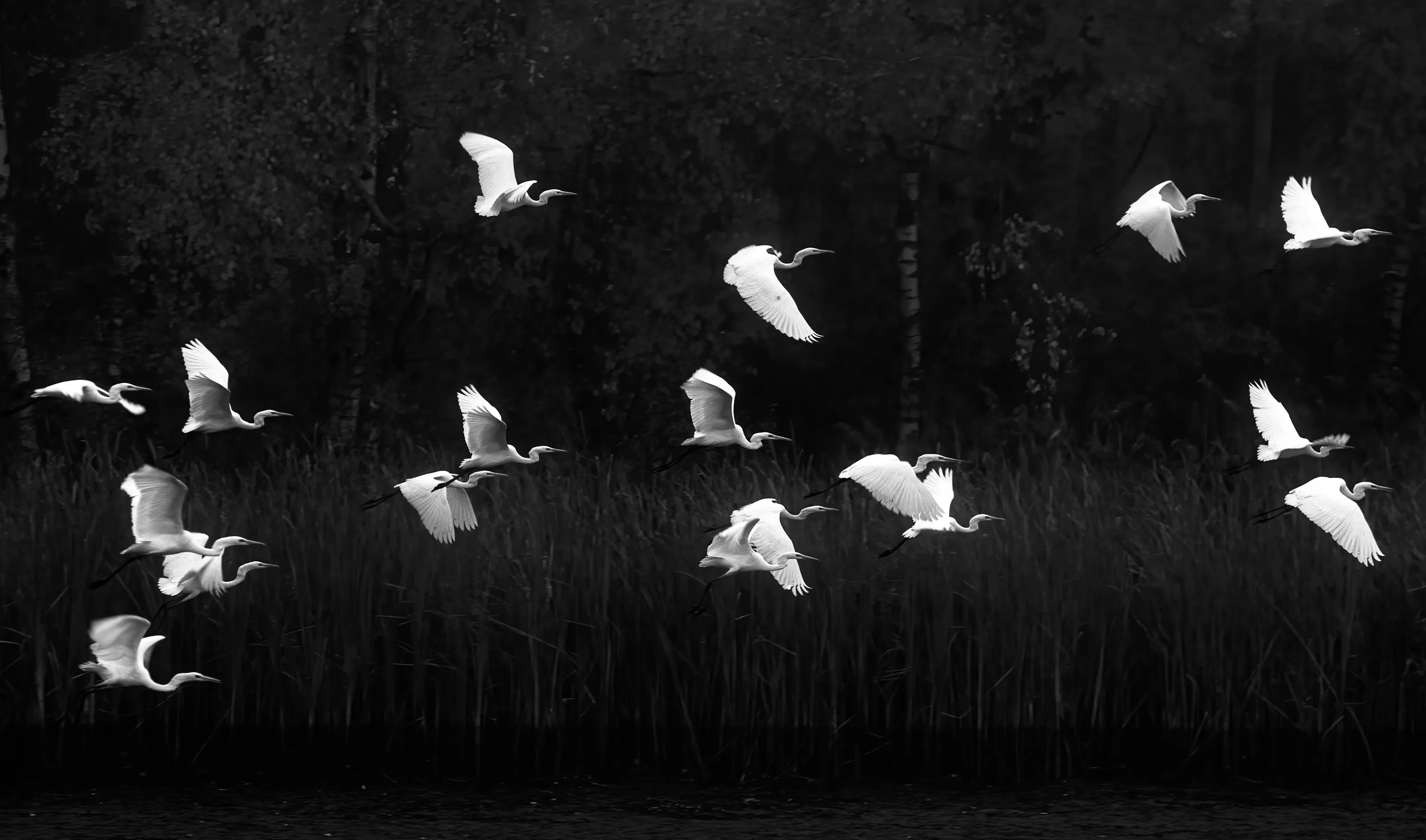
There is a pleasing simplicity to this image. The decision to go black and white and stick with muted high key tones has lifted this image from what could have been a fairly standard record shot of an Egret into something with a much more fine art feel. I can imagine a giant print of this on a wall.


The juxtaposition between the two figures in this picture really make it stand out. One can't help but wonder what Abraham Lincoln would have made of modern inventions such as the smartphone, and its seemingly all-powerful hold over us. The framing is fantastic, and the lines work well to create an excellent sense of scale. Well observed.


Sometimes a scene just presents itself, and Vincent says this was the case with this causeway in Weston-Super-Mare. However, despite needing quick reflexes, he has also taken the time to wait until the three figures are between the uprights, and with their legs apart so there is no confusion or blending of the sparse detail. We love the bold, high-contrast treatment, too.


If there’s one thing that a B&W image can always create, it’s a sense of mystery. Here, Laura has captured a moment that’s like a still from a film noir. We are left wanting to know who the man is, where he has been and where he is going – but we have to apply our own interpretation, which is what makes the shot is so memorable.


Images like this show us how beautiful work can be created from the simplest of subjects. It inspires us to find subjects in our own neighbourhoods in even the most mundane of situations. The high contrast and the shuttered blinds creates an impression of a bright sunny day even though this image is in black and white and contains no sky - an impressive feat!


Few things lend themselves better to the B&W treatment than a scene that’s made up of lines – both curved and straight. Angela saw some excellent potential in this scene Without the lone figure, it would have been pleasing enough, but waiting for the person to appear in frame, and releasing the shutter just when they are at the right spot, it what elevates it out of the ordinary.


The trees alone would have made this an atmospheric, minimalist shot, with their spindly branches standing out in sharp relief against the snowy background. Add in the cantering collie, however, and the image is really brought to life. She brings scale and context, and an enjoyable element of fun to the scene, and the overall high-key effect, which eliminates any potentially distracting detail in the snow, finished everything off beautifully.


Another image that adheres to the rule of keeping things simple, albeit in the landscape rather than the studio this time. By composing with the house so small in the frame, Helen has increased the sense of bleakness and isolation that pervades the frame. The gradation of the sky creates a sense of gloom and foreboding, and the subtle hint of mountains in the background give just enough context to the scene. The conversion to B&W is skilled and sensitive, with the lightest of touches bringing in detail and a gorgeous range of tones.


A sweeping concrete curve such as this cries out to be photographed, and Dave has definitely done it justice. He’s kept exactly the right weight at the top and bottom of the frame, which anchors that staircase beautifully, and despite the mass of grey, he’s processed it with a lightness of touch that is commendable, retaining just the right level of detail and texture in the floor, ceiling and wall. All it needed to complete the scene was a figure, and here he is, starting his ascent to… who knows where?


Photographing nudes has to be one of the trickiest genres to master, and Cathy has done a superb job here. The soft lighting from above wraps around the model beautifully, and the gradation of tones gives the result real depth and dimension. And while the pose is unusual, it is soft and assured, and doesn’t look awkward or forced in any way.
Meet the expert judge


Brief
See more contest details
A black & white image has a certain something that colour photography simply can’t emulate, and the pursuit of a great monochrome picture is something many photographers devote their whole lives to. The joy of this category is that it is completely open – any subject goes, because the medium is equally stunning whether you shoot landscapes, portraits or go down the classic route of street photography. It’s always worth shooting with a conversion to black & white in mind – don’t make it an afterthought. Instead, when taking your images, consider things like form, tonal range, negative space and shape, as these elements become even more crucial when colour is absent. Try to head out on a shoot with the aim of working only in black & white, and you will start to see images that lend themselves to the medium everywhere.


