
The light on this arachnid is beautiful and highlights all the tiny hairs and markings, as well as the fine strands of its web. The focus is on the head, but I can’t help wanting more of the body to be in focus. Also, I would like a little more space for the spider to ‘travel’ into at the bottom. It’s a lot to ask, especially when even the lightest breeze can throw everything out of focus, but these small details can take a picture to the next level.

Some objects say so much about a person and this lovely collection of threads, measuring tapes and sewing needles speaks of a lifetime of mending and making do. The sections in the drawer act as physical dividers, but they also act as visual dividers – asking us to look at each section in turn. Personally, I would have given the drawer more space on all sides and photographed the scene as a vertical, but it’s a lovely still life.

Shooting close-ups is the perfect excuse for playing around with everyday objects and abstract shapes. Here, the end of a cup of coffee has been turned into what looks like a planetary event! It’s well seen, and the photographer has pushed his/her equipment (an Apple iPhone) to the limit (and a bit beyond) to capture the scene. Aside from the small technical flaws, I would like to see the bottom of the cup centred in the frame – a quick crop would do the job.

I’m a big fan of minimalist compositions, but this takes it to the extreme! Shooting the edge of the espresso cup (rather than the whole) is a great idea – when we are shown part of a familiar object our brains tend to complete the shape which makes things interesting! I love the high-key look, but we really need to see more of the cup to appreciate its subtle lines and curves.


The square crop is a good choice here, with strong diagonals drawing our eye to the centre. However, the technology (a mobile phone in this instance) has really struggled to capture what the photographer had in his mind’s eye. I’m assuming this was a heavy crop, which I like, but the original needs much more data to be able to handle such treatment.

Shooting fungi can be tricky as it often hides away in woodlands with low light. Here, however, the light coming through the canopy has led to wonderful bokeh, which the photographer has, quite rightly, chosen to make a feature of. It’s a pleasing shot, but the caps of the fungi need to be sharp, rather than just the stems. It’s a balancing act, often helped by focus stacking.

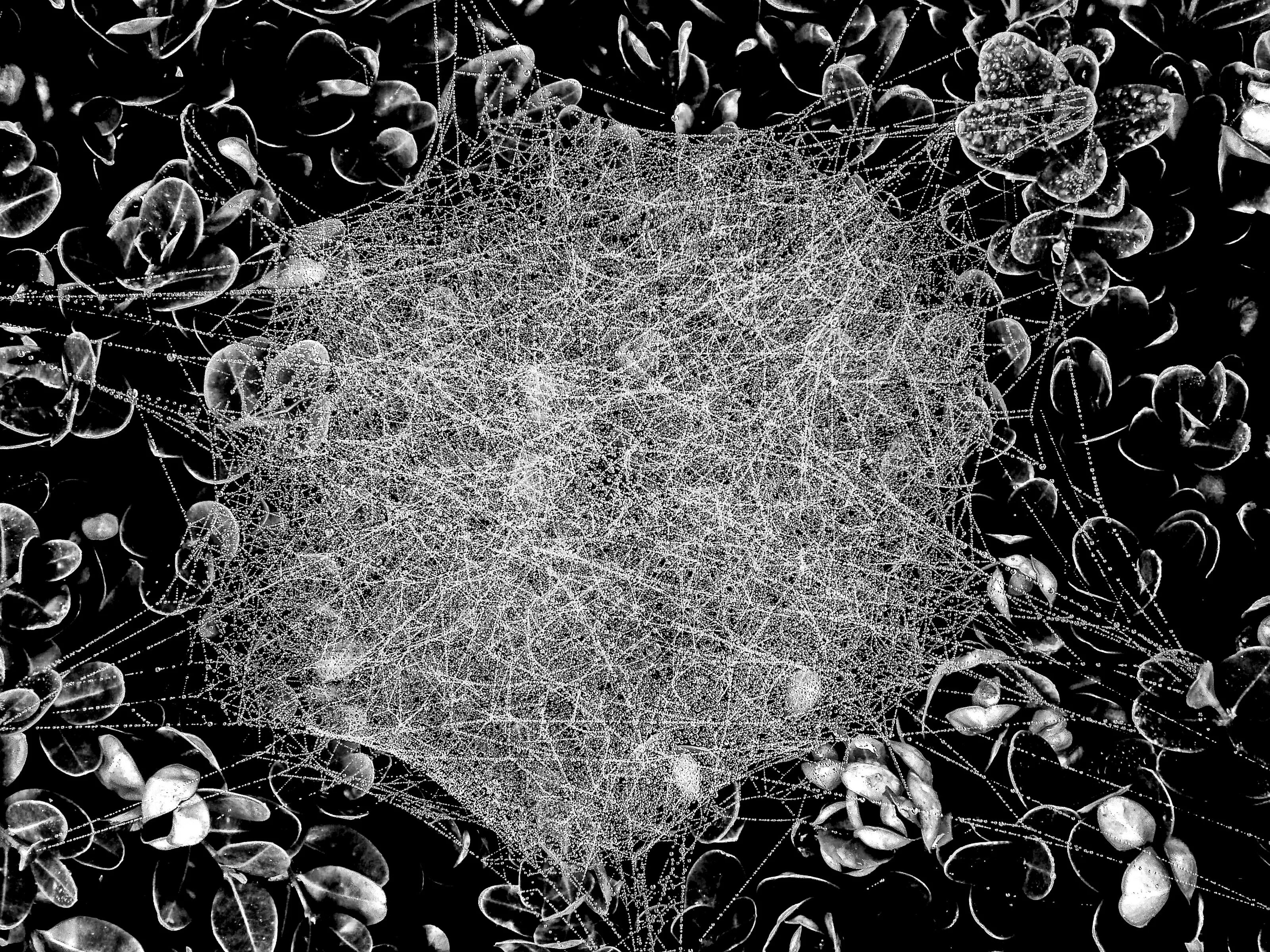
Shot in colour, this image might have felt too chaotic, but rendering it in black & white has helped to simplify the scene and allow the viewer to pick out individual strands of the web. The dew adds a touch of magic, while an aperture of f/8 has allowed just enough detail to be retained in the leaves supporting the web. It feels like you are being sucked into the centre!

1,170 Photographers


This is a wonderfully observed scene. The viewer’s eyes follow the lines of ice, stopping to take in different shapes and sections along the way. It’s a never-to-be-repeated marriage of water and rocks. My only problem is with the line dividing the frame almost exactly in half. When compositions are divided this way, it can be confusing for the eye, causing us to flit from one side of the picture to the other, not knowing where to settle. Composing (or cropping) the picture so the line falls slightly to the left or right would show us where the eye should settle.


Spirals are naturally very pleasing to the eye, and this one reaches a dramatic conclusion with the group of vertical flowers. The sculptural form of the succulent suits the black & white treatment nicely. Using an ISO of 800 has allowed the photographer to use an aperture of f/20, which results in plenty of nice detail.


3,451 Images entered


Meet the expert judge

Brief
See more contest details
A macro contest that focuses on tone and form, such is the feel of black and white photography when it gets up close and amplifies the textures, shapes and shades of things. The subject is up to you, so might be natural or man made, recognisable or not. The emphasis is on macro photography, stripped of its colour. A little colour toning is fine if that's your thing, but images must be monotone.


The focusing has been well handled here – the viewer’s eye is drawn straight to the centre, where the pistil acts like an eye. The toning is nice and suits the soft, delicate nature of the picture. My only complaint is the cropping feels a touch too tight at the top and bottom. If more space wasn’t possible, cropping to a square format might help balance the picture.


This is a nicely composed still life: the handles of the razors are positioned on the diagonal, the box and cylinder add height, and the lines and shapes on the surface and background create nice paths for the eye to travel down. However, trying to bring out the texture and lift the shadows has given the image a serious ‘HDR’ look. Shadows and a certain level of softness are completely natural to the eye, so don’t be tempted to eliminate all of them.


This picture has some wonderful elements: the light coming through the leaves highlights the venation, the strong diagonal adds dynamism, and the bokeh in the space between the leaves is very pleasing. My only complaint is that the eye goes directly to that central space and, essentially, there isn’t much there to hold our attention. Cropping so that the leaves and the gap occupy equal parts of the frame might be a way of addressing this.

Love-in-a-mist are wonderful flowers to photograph and the feathery bracts that stretch out from the petals work well in black & white. Choosing an aperture of f/3.2 has helped to blur the background, but I can’t help wishing I could see more of the bracts in focus. It’s a lovely shot, but it has been a touch overworked in post processing.


This is a wonderfully graphic image with strong diagonals contrasting beautifully with the curly, spiralling palm leaf threads. The light coming through the leaf has helped to reveal all the lines and texture, and the photographer has done well to find a section of palm leaf that isn’t damaged. If I were to make one adjustment it would be to crop the image to concentrate on the two spirals on the lefthand side – that would stop the eye from following the central lines and shooting out of the top of the frame.


