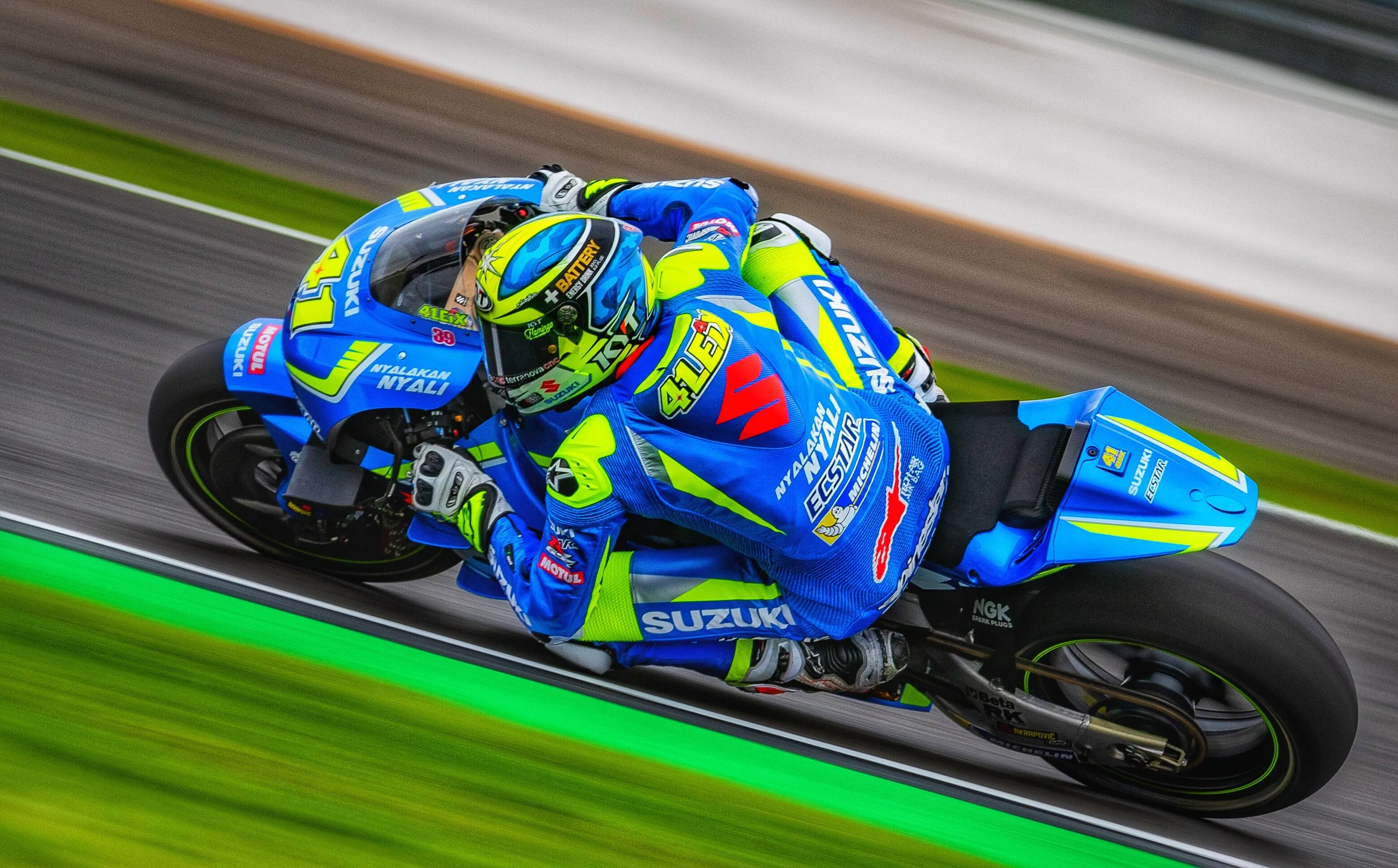


We have an image here that contains so much to enjoy.
The rider is razor sharp which demonstrates the photographer has got their focus point spot on. They have selected a shutter speed of 1/320 sec, this would appear to have been perfect for the speed at which the rider is travelling at. (I mentioned in a previous review about experimenting with shutter speed). 1/320 sec while fast enough to freeze the rider it is slow enough to render movement in the tyres.
The position of the rider is perfect. As he comes out of the corner we see his eyes looking down the track for the next apex. His left knee is out to lower his centre of gravity and is just scraping along the tarmac.
There is a small crowd in the background which gives us a sense of 'place' for the image.
Finally the crowd appear to be blurred by the heat generated from the bikes engine as he powers out of the corner.
At longer focal lengths the depth of field reduces, to counteract this the artist has selected an aperture of f13. This provides enough depth of field at 467mm focal length to render the bike in focus but not the background/crowd.
Finally we can enjoy the crop the photographer has used. They have included everything that adds to the image and excluded everything that doesn't. We don't need a bland sky so the photographer has chosen to crop the image just above the heads of the crowd. They have also not cropped through the crowd but left a little space on the far left side as we look at the image. This infers that it was a deliberate decision to frame the crowd behind the rider.
On the right side of the frame we have some 'negative' space, the helps to draw the viewers eye to the main subject and at the same time it gives the rider an area to accelerate into.
We all know that compositions are rarely perfect, there are lots of distractions we photographer have to deal with but with the skilful cropping of an image we can convey an element of 'order' to our images.
There really is a lot to this image and so much we can all learn from it..

This is an image that grew on me the more I looked at it.
The photographer has nailed the competition brief 100%. They have demonstrated mastery of the art of panning to produce the impression of movement while rendering the main subject 'sharp'.
They have used a shutter speed of just 1/80 second to capture a fast moving race car and blur the back ground. For those of you that haven't tried 'panning' the technique is to select a slow shutter speed and then as the vehicle passes in front of you, you try to follow the vehicle by moving the camera at the same speed as the vehicle is travelling. Not only do you need to move the camera at the same speed as the vehicle but also keep the camera on the same plane as the vehicle. Yes it really is as difficult as it sounds!
If you fancy trying this for yourself I would suggest you start by positioning yourself just before or just after a bend in the race track. This will mean the vehicles will be travelling a little slower and should result in a better chance of success. You also need to be perpendicular to the vehicles direction of travel.
With your camera at eye level bring your elbows into your sides to 'lock' the top of your body. As the vehicle passes you, twist your body from the waist - try to match the speed of the vehicle, keep your camera level and press the shutter all at the same time.
Most of us will end up with plenty of unusable images due to moving the camera too fast or too slow resulting in everything being blurred but do not become discouraged. Keep practicing and eventually you will be able to match your camera rotation to that of the vehicles and the number of sharp images will increase. You can then move on to a high speed straight and try to capture the vehicles when they are at full speed.
In this image the photographer has nailed the main subject. I also love the way the colours of the car are replicated in the stands behind, reds, greens, white and black. This harmonises the image and provides a connection between main subject and background.
I may have been tempted to go a little easier with the saturation as the colours are a little over saturated for my tastes but there is no doubting that this is a great example of panning.


Another image of a rider frozen high above the photographer by using a fast shutter speed.
The difficulty in these kind of images is finding the right location for the light to illuminate the subject. Modern cameras can easily auto track the subjects against such a clear background. Modern sensors have such high resolution that we don't even have to be too accurate with the placement of our subject as we can crop in and still have a decently sized image.
This should not be taken to be a criticism of these images, I am just pointing out the facts.
This image has been cropped really well to exclude anything that doesn't improve the image. The crop also places the main subject on the right of the frame, this give us space on the left into which the implied movement of the subject can move into.
I suspect the artist has carried out a bit of post processing as the rider and bike appear to have an HDR like appearance. There is also a slight bright halo around the rider and bike which again is suggestive of some extreme processing having been carried out.
When it comes to competitions like this where the standard is so very high, small issues like this are the only way judges can differentiate between some outstanding images.
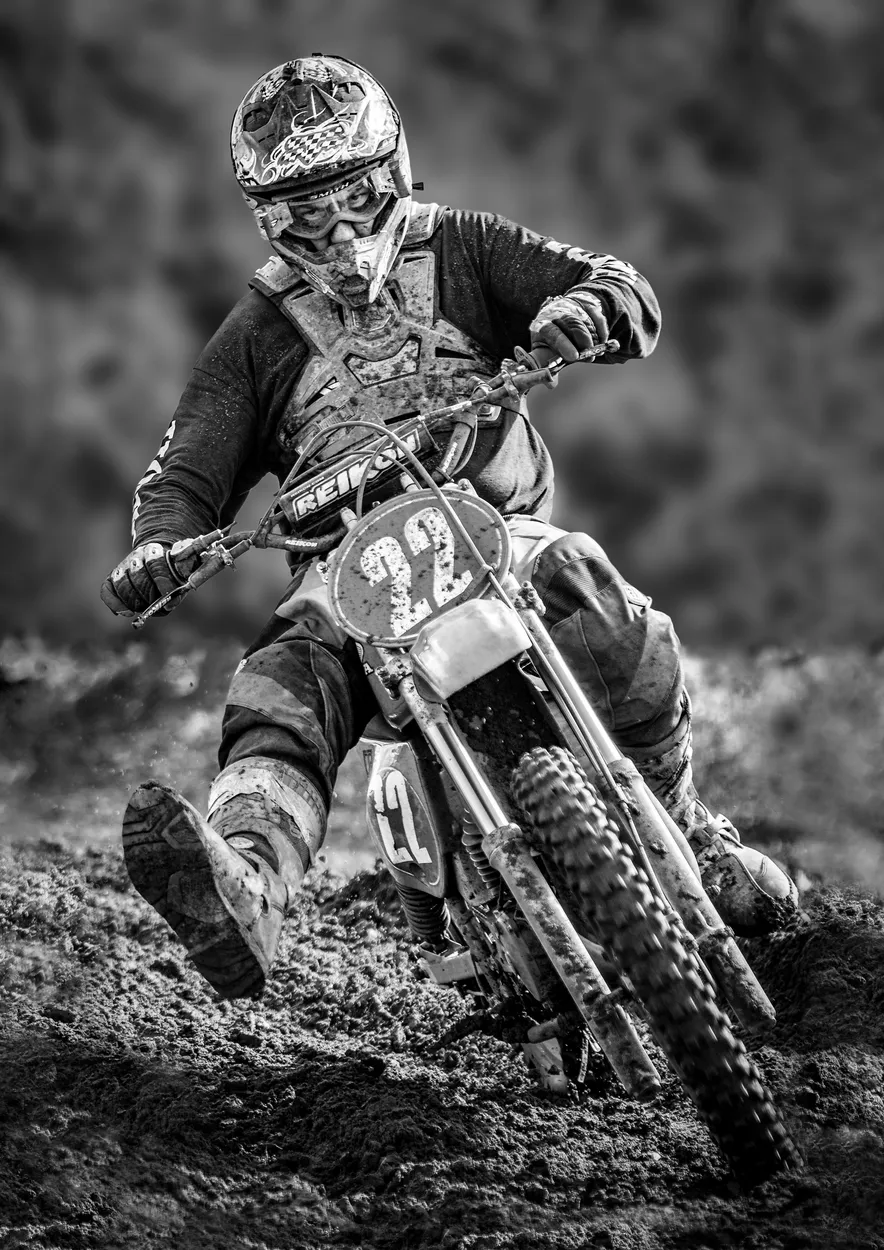
This is an image that is all about the eyes of the rider, they stare out from behind the helmet with a steely determination and grab the viewers attention.
Once we drag ourselves away from the eyes we also notice the riders right leg outstretched which provides an added dimension to the image. It provides us with an impression of the rider battling to maintain his balance while travelling as fast as he can over rough terrain.
The photographer has chosen a relatively fast shutter speed, fast enough to freeze the movement of the rider yet there is still a slight motion blur to the front tyre. As a photographer of motorsports we need to play about with our shutter speed, we need it fast enough to freeze the movement of our main subject yet slow enough to render movement in the faster moving items in the frame. Items such as the wheels or mud/dust etc. We accomplish this through trial and error. In this situation the riders won't be travelling as fast as a F1 car down the main straight so we can try utilising slower shutter speeds.
The photographer has also selected an aperture of f3.2, this gives a very shallow depth of field. Just enough to render the rider 'in focus' but the background becomes out of focus. The reason for an out of focus background is that is helps make the main subject stand out more.
By turning the image to black & white the artist has removed any distracting colours from the image which might draw our attention away from the riders eyes.
A really well thought out and executed image which demonstrates that the photographer is in control of their camera.


A beautifully captured image.
The lighting is beautiful, fully illuminating the main subject and giving depth to the clouds of dust being thrown up behind the rider.
The rider is sharply rendered in focus, this is helped by the 1/2500 sec of shutter speed with his eyes seemingly staring right at the camera.
The 400mm focal length and f6.3 aperture helps to isolate the main subject from the background.
The exposure is perfect, rendering the colours and textures wonderfully well.
Part of me is saying this image is too perfect to be a straight shot but I can't find any evidence to support my nagging doubt.
Reading through the photographers notes they don't admit to any post processing other than adjustments to the light balance.
So I have to take my hat off to the artist, this a really high quality image, perfectly executed and a well deserved winner of the competition.


A great image that has everything - drama, great lighting, movement and impact.
I am certain there has been a fair amount of post processing done to produce this final image but it has been carried out delicately. That is the key with post processing, go to heavy with it and the resulting image looks false. While the background has been darkened it allows the rider and the exhaust gasses to stand out, which creates the visual impact. I am not certain the artist who made this image had a clear idea of how he wanted the final image to look as they submitted more than one version but this, in my opinion was the best.
When selecting images you are going to work on in post processing the old adage 'you can't make a silk purse out of a sows ear' holds true. The starting image has to be of a high quality. No amount of post processing will turn a poor starting image into a great final one.
At 1/2000 sec shutter speed the movement of the rider will have been frozen/sharp. The aperture of f4.5 at a focal length of 81mm will allow for a depth of field of around 10m. This is plenty to allow the rider to be sharp and start to throw the background out of focus. However I do believe some additional blurring would have been applied to the background in post processing.
I think the image may be improved slightly. When we view images our eye is usually drawn to the brightest part of the image. As a test - close your eyes, count to 5 before opening them. What is the first thing you see in this image? For me, my eyes went initially to the rider but very quickly got drawn to the bright area of the exhaust gases just beyond the bikes exhaust.
As a photographer we want the viewers eye to go to the main subject of our image, then wander around the image before being drawn back to the main subject. In images like this, we can accomplish this by making our main subject the brightest part of the image.
Try brightening the rider and bike slightly, and/or reduce the bright area of the exhaust gases.
An image with great impact, well done and worthy of a place in the Top 10.


1,637 Images entered
Brief
See more contest details
The art of motorsport photography is part mastery of shutter speed and panning - capturing sharp images of speeding hunks of metal - and part documentary/reportage photography - embracing the world of motorsports, its characters, the experience of being at the races as a competitor, spectator, marshal. And if this is not a world you’re familiar with, here’s your excuse to go and mix it with the petrolheads for a day or two.
810 Photographers
68,173 Ratings
Meet the expert judge


I really wanted to comment on this image as the photographer has really done exceptionally well.
A lot of entrants in this competition have made the choice to make their images using a high shutter speed to freeze the action. Whereas here we have a photographer who has used a slow shutter speed and using his skill at panning to freeze the action. This really is a difficult skill to master so my congratulations to the photographer.
We can see the rider and bike are sharp but the foreground and track are blurred due to the panning movement of the camera. The wheels of the bike are blurred due to the slow shutter speed and give us the impression of movement.
The icing on the cake is the flame coming out of the exhaust, this adds extra drama to the image and lifts it to the next level.
A superb image that totally meets the brief for this competition and showcases the skill of the photographer.


Another image that nails the brief of this competition and showcases the skill of the photographer.
Unless you have tried it you won't know how difficult it is to pan your camera at the speed of a race car going flat out using a 200mm focal length and a shutter speed of 1/50 sec. The margin for error is enormous, it take great skill to capture an image like this.
It might not be as spectacular as some images that have been submitted but for the shear skill of the photographer this image is one of the very best.
Not only is the capture technique wonderfully showcased but also their selection of camera settings. After deciding on a shutter speed of 1/50sec there is the potential for such a slow shutter speed to let in so much light that it over exposes the image. To prevent this from happening the artist has used the lowest ISO of 100 and then adjusted his aperture to control the amount of light hitting the sensor.
Under normal circumstances this would create a large depth of field and cause the background to be rendered almost as sharp as the main subject. However when panning we know that the background will be blurred due to camera movement so we don't have to worry about depth of field.
A really good example of panning. If we could have some dramatic lighting then this would quite easily have made the Top 10.


There is no doubt that this is a stunning image, beautiful lighting, sharp, dramatic and conveying to the viewer the impression of high speed.
Part of the contest brief reads "The art of motorsport photography is part mastery of shutter speed and panning".
Nowhere in the brief does it mention creating these ideals on a computer, in fact the brief clearly asks photographers to demonstrate their mastery of shutter speed and panning. My impression is that this image is a composite image. Apologies to the artist if I am wrong in my assumption.
Why do I think this has been created from different images rather than a single image? There are a number of factors:
the car is in sharp focus yet the area of gravel under the car is blurred, this can't occur with a 'straight' image as the plane of focus necessitates everything on this plane must be at the same level of sharpness. Unless the image was taken with a tilt/shift lens.
The shadow under the car looks as if it is hovering above the ground, this suggests it has been digitally created.
The main light source appears to be coming from the right of the frame yet the front of the car and the left side appear to be equally well illuminated. There is only a very slight shadow on the top of the car's right wheel arch and the right bumper. This again suggest the light source is placed on the front/right of frame. Yet the dust behind the car is darker on the right side of the frame than it is on the left.
So in my opinion the overall image has been created digitally and that doesn't totally fulfil the competition brief.
What I will say is that this image demonstrated what can be achieved with inspiration, planning, control of artificial lighting and some advanced computer skills. It is an image to inspire us and shows what is possible but sadly doesn't make the Top 10 due to not fulfilling the brief whereas other photographers have.


A lovely image taken during an Indy Car race. The photographer has stationed themselves just after a turn on the race circuit which means the cars will be accelerating towards them. As the power is unleashed the heat from the engines rises and creates a blurring effect which adds to the drama. My only reservation about this image is that there appears to be some processing artefacts which show up and once seen continually draw my eye to them. If you look closely at the cars front, right tyre (the left tyre as we view it) you will see a slight, unusual shadow on the outside of the tyre and beneath it. This isn't a shadow caused by the sun as the sun is somewhere outside the frame, to the top left area as can be seen from the shadows under the leading car and extending to the right. If the 'unusual shadow' isn't caused by light, it must have been introduced during processing. I suspect it was a 'global' processing action that created it as there is evidence of s similar shadow on the car behind.
It is only due to the exceptionally high standard of images in this competition that small inconsistencies like this can mean the image doesn't make the Top 10.
A really nice image that could be improved by a more gentle approach to the processing and sharpening that has been applied.


A really nice action shot of a motorcycle racer.
The artist has captured the action beautifully, the rider is accelerating, their eyes fixed firmly on a point on the track ahead of them and the front wheel is slightly off the ground..
The photographer has chosen a shutter speed that is fast enough to freeze the slower moving subjects like the rider and bike, yet slow enough to allow for movement in the faster moving items such as the wheels and tyres. In addition the photographer has 'panned' the camera slightly to maintain the sharpness of the main subject while blurring the background, this enhances the sense of movement in the image.
A very well executed image. Moving forward I would suggest the photographer could lower his shutter speed even further to maybe 1/60 or 1/125 sec. There is no doubt using these speeds will result in fewer 'keeper' images but they will enhance the sense of movement by blurring more of the background and bike wheels. It will also give plenty of opportunity to practice the art of panning.


This is a motorsport image where using a fast shutter speed works really well. A quad bike sliding around a corner throwing up great quantities of mud and dirt, due to the fast shutter speed this is mostly rendered sharply in the frame. Just the faster moving pieces have a slight blur to them which helps convey the impression of movement and speed.
I think the square crop works really well as it isolates the main subject for the viewer. The green of the riders outfit and bike contrast really well against the brown of the mud. It provides an artistic, limited colour pallet to the image. Just green, brown and the white of the riders helmet.
A really top class image.


An image that has everything - colour, composition and the impression of a story.
I love the crop that the artist has employed, it isolates the subjects in the image that they want the viewer to look at. We can all learn from this - in any type of photography whether it is landscape, street, portrait or sports - crop your image to remove anything that doesn't add to it or is distracting. Here the viewers focus is totally on the riders. Any other riders and the crowd have been cropped out.
There is colour in the image to attract our attention, they have been enhanced by the lighting and I suspect some careful processing. The background is dark which also helps the colours and main subjects stand out.
There is a story to fire the imagination of the viewer. The rider in the yellow helmet appears to be anxiously looking behind him, are they wondering 'if' they are about to get overtaken or are they just confirming that they are in control? It is these 'inferred' stories contained within our images that take them to the next level.
Finally the image appears sharp in some places but less sharp in others.. As a photographer we need to have a clear idea of 'what' message we want to convey to whoever views our image. One of the ways we do this is by making the main subject in our image the sharpest part of the composition and everything else less sharp. This drags the attention of the viewer to the area in the image we want them to focus their attention on. This is even more important when we are trying to tell a story with our images.
What is the main subject in this image? The narrative would indicate that it is the rider in the yellow helmet who is looking behind them to ensure they will not be overtaken. Yet this rider is the least sharp of the four, even the riders at the back of the four appear sharper than the rider who is in the lead. As we view the image, the rider in the white helmet would appear to be the main subject due to the lighting and their apparent sharpness. This then leads to a little confusion in the mind of the viewer, the image should be all about the leader of the race anxiously trying to maintain their lead, not about the rider in second place - who dominates the frame in terms of sharpness and lighting/colour.
It is just something to be aware of when selecting images for competitions. This should not detract from what is a beautiful image.


A spectacular image of a bike rider in mid air performing trick.
Both bike and rider are perfectly sharp, their dark colours contrast nicely against a bright sky. This results in a nice, spectacular image, however not one that makes the Top 10. Why?
In all honestly this kind of image does not require much technical ability, just set your camera to a fast shutter speed, find a location by a jump and with the sun in the right location and fire away. With the subject tracking technology in modern cameras you are assured of a sharp image most of the time.
If an artist wants an image like this to compete they have to show a little more 'creativity' in their images. Show the judge or viewer an image that demonstrates your mastery of the camera. Check out other photographers work for ideas/inspiration, some will even tell you their techniques. For motorcycles and images like this check out someone like https://daveblackphotography.com. With just a few 'flashes' he takes images like this to a whole new level.
Like all things it will take time to master the technique but once mastered you will be creating images that not only demonstrate your mastery of the equipment but will also astound viewers and judges alike.


Once again the artist has chosen a high shutter speed of 1/1600 to freeze the action. In this case I really think that choice works really well. It helps to freeze the spray being thrown up behind the jet skier as he rounds they bout, which servers to screen the background and helps to isolate the main subject. The aperture is f9 which at a focal length of 600mm will give a very shallow depth of field, this again helps to isolate the main subject.
The artist has chosen their shooting location with the light source behind them, we can see that from the reflection on the green body and on the jet ski. This position of the main light source enables the main subject the be fully illuminated which in turn improves colour rendition and apparent sharpness.
What sets this image apart from the others are the colours contained within the composition. The green of the bouy complements the green decals on the jet ski and there is also a hint of green in the spray. This harmony of colour added to the skill of the photographer makes for a really compelling image. Finally as with all top images the crop is perfect. I have mentioned cropping in many of my reviews of images in this competition. The artist has chosen to exclude anything that might distract viewers gaze away from the main subject.
A really high class image.

